Showing posts with label Documentaries. Show all posts

Wednesday, September 11, 2013

Review: "The Rugby Player"


As a new New Yorker, I'm not sure if I'm even allowed to commemorate 9/11 like the people who lived here when the attacks occurred. This was my second 9/11 in town and to say that things feel different would be a lie, there are no mournful faces in the subway, newspaper magazines remembering the tragic date are lost between portraits of Miley Cyrus and a Kardashian sister on the tabloids and traffic never ceases; after all this is the city that never sleeps.

As someone who now lives here, and as a human being who can't help but be moved by insurmountable tragedy, I can't help but be more pensive on a date that reminds me that all of this could just end without a warning. What if someone, somewhere decided to hijack a plane, wear an explosive vest or craft a homemade bomb in his basement and I unexpectedly became a victim? These were the thoughts I, morbidly, kept trying to avoid while watching The Rugby Player, a fantastic documentary that celebrates the short life of Mark Bingham, one of the heroes of United flight 93.

Reflecting on one's mortality in the face of other people's death might be the most natural thing to do as people and watching Bingham's life onscreen constantly reminded me of that quote from The Hours in which Virginia Woolf expresses "someone has to die in order that the rest of us should value life more." This might not be much solace to the people left behind by the deceased, but on few occasions had I been so touched by the consequences of a life that at first glance seemed so un-extraordinary.

The Bingham we know through the news is the gay martyr who decided he'd rather go down with a plane than to see it destroy lives in Washington D.C., the Bingham we meet in the documentary is so much more than that: he's a man. A man who once dreamed of being rich, who starred in silly spoofs of hard rock videos with his friends, a man who at one point decided every memorable moment in his life would be recorded and saved for posterity (would he have approved of all the "found footage" movies we're subjected to yearly?), a man who chose rugby over drama club, a man who once came out to his mom because he promised himself he would do it before sunset on a random day, a man who loved a man, a man who was loved.

The Mark Bingham we meet onscreen is a man we would've liked to know in real life and that is something rare nowadays. "He's still wiser than me" says hi mom, former airplane stewardess Alice Hoagland - a woman so vibrant and warm that she's a Meryl Streep character in the making - as the documentary shows us how she took on the role of activist after her son passed away. Watching her serene demeanor as she remembers her only child breaks your heart, but watching the sense of purpose with which she works to celebrate his life is utterly inspiring. At the screening I attended tonight where she was present, she tearfully thanked her son for showing her her life's purpose and this is exactly where The Rugby Player succeeds as a film.

It reminds us that yes, life can be horrible, merciless and devastating, but it also implies a sort of mystical energy in how everything leads to where it should lead. Bingham's loss was terrible (as were the hundreds of other victims that day) but director Scott Gracheff makes a wonderful point out of connecting randomness and chaos to create beauty. Would Mark ever have guessed that one day he would be remembered in a field in Pennsylvania? Would he have imagined that one day a rugby championship - made for gay players - would carry his name? Would he ever have pictured his mother as a heroine in a cause which she confesses she only understood after her son's passing? The Rugby Player is a precious little film that transcends the limitations of sexual orientation, biographical conventions and  indiscriminate manipulation to remind us that we all have a reason to be in the world and it inspires us so that we tap into it and use it to share love, because in the end that's the only thing that remains.

Wednesday, June 19, 2013

Saturday, January 19, 2013

Sheet-y Saturday (Fave Posters of 2012)

In no particular order (both because I'm lazy and because I really like them all)

Portrayed the exuberance and joi de vivre the film teasd about having but ended up lacking. It's an image of pure joy captured in a single moment.

Merida gives her back to the world proving just how she's setting herself apart from all other Disney princesses. Brave move indeed.

After reading Pattinson and then Cronenber, you're like "wait, what?" but the matinee idol's look of quiet despair hooks you.

If ever a movie's visual idiosyncrasy was captured by its poster, it's this. 

You can not look at this and not giggle. If only the rest of the marketing campaign had been this Hitchcockian...

Saul Bass brilliance for a noble cause. 

It's like a flyer from an actual strip club. You just wanna do jello shots after looking at it.

Like the cover of a 70s exploitation movie or a bad paperback. 

Promises a mystery larger than what the movie actually contained. 

This redacted title with no movie star names, no "from Oscar winning director" and no release date might be the greatest movie poster of the year (maybe I did have a favorite). Simple, effective and haunting.

What were your faves this year?

Monday, February 20, 2012

Short Take: "Nostalgia for the Light" and "Pina".

The Atacama Desert occupies over forty thousand square miles of northern Chile and is known for being the driest desert in the world. Its elements have been compared to Martial soil because absolutely no living organism could thrive in it. Director Patricio Guzmán argues that it's in this desolate place where the universe has created a portal where the past, present and perhaps even the future run into each other, but fear not, this isn't a sci-fi film, instead what the director creates is a moving non-fiction essay that contemplates our existence and how passing time is both tragic and solacing.
Guzmán is a child of the Chilean revolution and as such he tells in detail how his country went from being an exemplary land to a hell where people were murdered or kidnapped if they opposed the system. The documentary interweaves three different stories: we have Guzmán's observations and soulful narration, testimonials from concentration camp survivors and the families of those who never returned home, and there's also interviews with astronomers who run the observation sites in the Atacama desert, all of whom have more in common with each other than they would've guessed.
Guzmán makes a strange, if remarkably convincing case, about how all these people are united by history and the creation of the universe (this film would make a superb companion piece to The Tree of Life) and the director also displays an expert's eye for bending elements of real life into a narrative that's absolutely spellbinding and profound. In all of its essay-glory best, the film proves that Guzmán is as deft a creator as any supernatural force.

Pina Bausch was a pioneer choreographer who updated the concept of Tanztheater: a complex combination of movements and staggering sets which brought a new sensibility to the concept of modern dance. Bausch's longtime friend Wim Wenders had wanted to make a documentary about her life but she passed away a few days before shooting commenced. The project was then rescued by her pupils, who seem to have an utmost faith in their instructor, and the result is Pina, a wonderful nonfiction film that works as a supreme showcase of her legacy.
The film consists of several breathtaking setpieces in which the dancers display unbelievable physical skills, as well as a mystifying unity with their surroundings. Several moments have us rub our eyes in disbelief as we see deft dancers jump over a gargantuan boulder as if it was nothing but a step high, and some other moments explore the duality of the sexes by having a frail-looking female dancer use her humongous arms to do delicate moves (but this one has a twist so be ready to gasp). What remains persistent throughout each setpiece is the way in which Bausch found beauty in all her dancers; from the young and slender ones, to the ones whose faces are so rugged as to suggest they're "has-beens" in the age obsessed world of the arts,  you wonder then if Pina, more than a teacher was a spiritual guide who helped these people transcend the confines of mortality through her choreography.

Grades:
Nostalgia for the Light ***½
Pina ***

Tuesday, February 14, 2012

What Better Way to Celebrate V-Day...

Than with the man who has explored the human heart like no one else?
Head over to PopMatters and read my review for Woody Allen: A Documentary.

Thursday, January 5, 2012

Short Take: "Senna", "Jane Eyre" and "Warrior".

Ayrton Senna was widely regarded as one of the best race car pilots in the history of sport and Asif Kapadia's masterful documentary proves why. The thrilling film closely follows Senna's trajectory beginning as an amateur and then going all the way to him being World Champion on three consecutive years. The film chronicles his rivalry with teammate Alain Prost, with whom he engaged in psychological warfare on and off the racing track. What remains so stunning about this film, is how it trespasses into narrative fiction while retaining elements of non-fiction cinema. Most documentaries make you aware that you are watching reality being bent and that for all you want to do about it, the events being related are unchangeable. What goes on with Senna is quite the opposite, the film is done entirely with archival and news footage (there are no modern day interviews or intrusive narration) all of this helps create a seamless chain of events that trick us into thinking we might be watching fiction. We know for a fact that we're not, but the narrative is so precise and flawless that we ask ourselves, why were that many cameras near Ayrton all the time? The entire film has an eerie prescience, as if the people involved knew one day these fragments of their lives would be used to tell a life story. With that said, the film avoids sensationalism, instead turning Ayrton into a mythical figure with a tainted human spirit. His love of god and country are as great as his ego (sometimes he sounded deluded, as if he was the Joan of Arc of racing) and for all the inevitability of its tragic finale, you always hope things will turn out different for him in the end. They don't of course, but Senna proves that truth can sometimes be much more harrowing than fiction. 

Out of all the English classic novels, it always results mystifying to ask ourselves how did the Brontë's oeuvre end up falling into the romance genre when their twisted stories of suffering among the English moors perhaps fit better in the category of horror. The greatest adaptation of any of their works is probably I Walked With a Zombie because it goes to the heart of its literary adaptation, Jane Eyre, removes all the romantic bullshit and sees it for what it is: a tale of sadomasochism disguised as love. With that said, most of the world chooses to see Jane Eyre as a tale of doomed romance and love conquering it all, which would make for an interesting essay on how messed up our conceptions of love are...but that's a whole different story. In this adaptation of the classic novel, the usually insipid Mia Wasikowska gives life to Jane Eyre, the suffering governess who goes through a Dickensian childhood only to end in an even more tortuous relationship with her employer, the damaged Mr. Rochester (Michael Fassbender). Director Cary Fukunaga goes the traditional way and turns the film into a showcase of classic studio filmmaking with gorgeous sets, a sweeping musical score and Judi Dench. Perhaps it's best to approach the movie as if you were watching a classic Hollywood production, given that Fukunaga injects little into it and like in his previous movie, some scenes offer themselves to be taken as parody (Rochester telling Jane how he's far from handsome comes to mind). It's great that Fassbender and Wasikowska put so much into their roles, because they make the film's artifice achieve a delightful balance.

Warrior is a movie that lingers dangerously between parody and serious filmmaking and can best be comprised by calling it: a greatest hits kind of movie. Taking elements that have worked before for similarly themed movies (although fans of it can argue that all films are versions of other films) director Gavin O'Connor brings us a tearjerker that combines Rocky, The Fighter, Karate Kid and a few biblical parables to create a movie aimed to please everyone. Tom Hardy stars as Tommy, a former marine who returns to the States and asks his ex-alcoholic dad (Nick Nolte) to train him for a mixed martial arts championship named Sparta (for 300 lovers). Meanwhile, Tommy's estranged brother Brendan (Joel Edgerton) is going through an economic crisis that forces him to sign up for the same championship in order to save his house from being foreclosed. Tommy, obviously, hides a dark secret about his days in Iraq and Brendan, who works as a high school teacher, must hide his new moneymaking scheme from his students (somehow mixed martial arts are the equivalent of prostitution to the film's Capra-esque characters) and of course the final showdown will be between the siblings, but which one should win? The real problem with Warrior is that it's so many different movies, that it ends up being none. The acting is quite good, Edgerton and Hardy are terrific and surprisingly sincere, but the plot feels forced and drags on for too long. If you've seen any of the movies it borrows from, you really don't need to bother with it...
However, here's a theory: the movie grabs a soldier and a schoolteacher - two of the most "heroic" and valued professions in the USA - takes away their "integrity" and pitches them against each other in a brutal fight for money. What is the film saying about the worth of morality in a world where the economy plummets constantly? Now, that would've made a much more interesting movie...

Grades:
Senna ***½
Jane Eyre ***
Warrior **

Wednesday, November 16, 2011

Some Musical Accompaniment.


Head over to PopMatters and read my review for Masters of American Music, a superb boxset dedicated to the history of jazz.


Wednesday, October 26, 2011

End of a Style Era.

Check out my official review for L'amour fou, over at PopMatters. This doesn't mean you get to disregard the haiku I wrote about it a few days ago though...

Monday, October 10, 2011

Model Citizen.

For the course of over four decades, Bill Cunningham has been one of the most iconic figures produced by New York City. His simple style, refined simplicity and love of fashion are remarkable. Meet him in Richard Press' lovely Bill Cunningham New York, one of the best documentaries I've ever seen!
Read my review over at PopMatters.

Tuesday, April 12, 2011

Plastic.


Click here to go read my first review for the awesome PopMatters.

Wednesday, March 9, 2011

Catfish ***½

Director: Henry Joost, Ariel Schulman

Boy meets underage girl, underage girl has a sister, boy falls for sister, boy loses girl, girl has bizarre secret (all of it happens through Facebook). That pretty much sums up the plot of Catfish; a creepy documentary that explores love in the times of social networks and the strange line that divides truth and fiction.
The film centers on the love life of Nev Schulman, a New York based video artist, who meets a fan of his work through the internet. Said fan is Abby, a little girl who also happens to be a child prodigy, making art that sells for thousands in her native town of Ishpeming, Michigan.
Abby begins sharing her work with Nev and soon he's friends with her entire family, including her mother Angela and oldest sister Megan.
Because Abby is too young to be in touch with a grownup, her mother and sister take over her conversations with Nev. Soon the young man discovers that Megan is a talented songwriter. They begin flirting, then sexting and before soon they're calling each other "babe". Then something happens and Nev (along with filmmakers Ariel Schulman and Henry Joost) decides to go to the core of the situation.
The young filmmakers do a superb job of editing their footage in such a way, that the story becomes a Hitchcockian psycho-sexual mystery (minus the preposterousness of those Shia LaBeouf movies which attempted to evoke the master).
In Catfish what we get instead is a disturbing, often heartbreaking, examination of how people strive to find connections in a world that makes them believe distance is only an illusion.
More than the eventual plot twist which unchains a series of shaking revelations, we wonder why is Nev so willing to believe in love from afar?
It's "easier" to understand Megan's plea; living in a distant town she might not have had the opportunity to bond with people who light that spark in her, yet Nev, an artist living in New York City finds himself in the same predicament.
This isn't a cautionary tale about the perils of social networks, this is a tale about taking risks to find love and as such it transcends the barriers of technology.

Monday, March 7, 2011

Short Takes: "Joan Rivers: A Piece of Work" and "Another Year".

The word is thrown around lightly nowadays but few people in the entertainment industry can be considered "survivors". Joan Rivers would be one of these people and as this clever documentary shows us, she's not just the loud mouthed, plastic surgery freak who disses red carpet dresses...she's the loud mouthed, plastic surgery freak who has survived forty years in the business and is still around.
A multi-talented performer, Rivers confesses she's only happy when she's onstage after she had revealed previously she never really wanted to do comedy and it's this kind of revelation which makes the movie such a refreshing entertainment.
As with any so called non fiction film you are left wondering what's "real" and what's staged yet the truth is that regardless of this issue, the film is superb entertainment. It makes you laugh, can move you to tears and sometimes even borders on something similar to enlightenment.
Fans of Joan will probably be thrilled to see her during her most intimate moments, people who don't know about her will leave the theater exhilarated and wanting to YouTube the hell out of her (even she does this in one scene showing her need to be up to date in technological advancements) and those who dislike her probably won't be converted but as a story about growing old this documentary can't hide its wisdom, even if it's usually covered in glitter.


After the strangely optimistic Happy-Go-Lucky it would've been easy to assume that Mike Leigh's next movie would possess the same sort of joie de vivre he seemed to have just discovered; however Another Year is instead an elegiac look at coming to terms with the deep dissatisfaction and regrets some might face as they become old.
The film, which is divided into four chapters (one for each season) shows us with situations peripheral to Tom (Broadbent) and Gerri (Sheen), a married couple who have to deal with their friends, their son (Maltman) and themselves.
The film consists of vignettes where we see these people interact and we begin to get to know them in a way. The movie is one of those where "nothing happens" and it becomes more of an intimate character study as we see how people around Tom and Gerry seem to be unhappy, while they appear to be rather content with their lives. We often see these people in private situations yet Leigh allows us to feel invited, his technical work is never intrusive.
Sheen and Broadbent both share very sweet personalities that make it easy for us to understand why the people around them, and the movie, have chosen them as a sort of moral center.
Perhaps the most interesting character around them is their friend Mary (Manville), an insecure divorced woman who fears aging without a partner.
Several scenes concentrate on Mary and her restless appeals to find someone to be with. Whether it's with Tom and Gerri or their son Joe, Mary seems terrified of being left on her own. She is played with fearlessness by Manville who doesn't seem to mind how obnoxious and pathetic Mary can become. Several scenes have her portraying some of the worst things about humans, yet Manville is so committed to her character and so devoid of any vanity that you can't help but feel, or at least try to feel for Mary.
Her last scene is a thing of heartbreaking beauty and makes everything that preceded it shine under a different light. Leigh's ability to take us from one emotion to another and in the process transform his movie from depressing to poignant, make this movie a truly bittersweet experience.


Joan Rivers: A Piece of Work ***
Another Year ***

Sunday, December 12, 2010

Exit Through the Gift Shop ***


Director: Banksy

What better way to explore what makes something "art" than with a film that itself is questioned for its artistic merits. Such is the premise of Exit Through the Gift Shop the documentary debut feature of iconic street artist Banksy.
His film concentrates on the rise of Mr. Brainwash, a street artist who made a name for himself out of the blue and has been hailed by the press and media for his refreshing of pop art.
When we first meet Brainwash, he goes by the name of Thierry Guetta. He's a French immigrant trying to make a living by selling old clothes at vintage prices.
Obsessed with recording everything with his video camera, Guetta becomes fascinated by street art and soon begins to make a documentary on the rising art form by traveling all over the world and meeting people like Shepard Fairey (of the famous Obama "Hope" poster).
Soon Thierry realizes he's missing the big one in his documentary and sets on finding the reclusive Banksy. He succeeds and develops a work relationship with the artist who suggests Thierry dedicates to art making and leaves the documentary in his hands.
With this simple twist, as one art form replaces another we can begin to ponder on the nature of what makes this movie a documentary.
Banksy is known not only for his stunning graffiti but also for being one of the biggest public pranksters in the world and everything about his debut film seems too good to be true.
How do we know for starters if the movie is even being made by him when nobody in the world knows his real identity?
When we see him here it's only from the back or in shadows using an altered voice. How do we know if this is the real work of Banksy when in the film he inspires Thierry to emulate his art.
The film explores this notions of fake and worth using techniques that remind us of a mockumentary minus the winks. We might say this is also a trait of Bansky's work and use it in his favor to attribute this work to him completely.
If the film is a hoax then Thierry Guetta has got to be one of the most fascinating fictitious creations in recent film history. Watching him in action is seeing someone so uniquely strange that we can't really bring ourselves to believe he's a fake. After all haven't we been trained to believe reality is usually stranger than fiction?
If he's in fact a character then we are witnessing work by an actor that could easily leave Paul Giamatti out of a job as the go-to-guy for down to Earth quirkiness.
That he's described in a serious tone as "someone with mental problems who happened to have a video camera" makes him even more compelling, as if he was just brought to the world to be the object of study and-why not-different characterizations.
Perhaps the most significant element in the film is the fact that at some point it becomes a palindrome of sorts. It begins with Guetta being a filmmaker and becoming an artist and finishes with Banksy leaving his street art on the side for a while and becoming a movie director.
If this sounds a bit too Bergman by way of Lichtenstein then the movie, whatever its real nature may be, might as well just had its way with you.

Saturday, December 4, 2010

Sheet-y Saturday.

Where we take a look at posters for upcoming features.


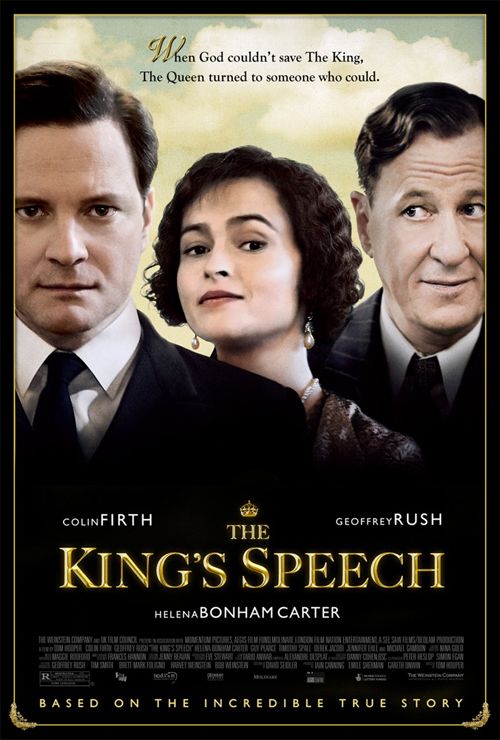
After the truly hideous design the marketing team over at the Weinstein Co. had made for The King's Speech, it's refreshing to see they finally came up with something that's not only lovely but also brilliantly executed.
Colin Firth's lips look thinner than usual and very well represent the dilemma at the center of the plot, notice how the microphone coming from above actually seems to evoke something godly and how the entire thing is a version of Michelangelo's famous painting of God and Adam atop the Sistine Chapel.
I'm thinking that the Weisnteins redid their campaign because they must know what ugly posters can do to Oscar movies...


I have to confess when it comes to documentaries I'm the most unversed person alive. All I know is Michael Moore, some Errol Morris, Herzog (LOVE his docs!) and a slew of the preachy stuff that always win Oscars.
However I have never seen what some think of as the greatest documentary ever made: Shoah.
When it comes to it I tend to think like Annie Hall "four hours of suffering!" but seeing how it's getting a new release I'm wondering if I've truly been missing out on something great?
Have you all seen it, should I stop being lazy and rent it?

Also, kudos to my friend Andrew for spotting this.
He gets the honorary Sheet-y Saturday badge of honor.

Monday, March 22, 2010

Garapa ***


Director: José Padilha

Garapa is a film about contrasts; it focuses its attention on the lives of three Brazilian families whose major ailment is extreme hunger.
When they can't afford milk, one of the families relies on garapa (a drink made out of water and sugar cane) to satiate its hunger. While a mother from another family has to hide milk so her alcoholic husband won't sell it to buy cachaca (ironically nothing more than fermented garapa).
This might be a too obvious example of contrast but director Padilha makes sure that his movie becomes more of a clash of ideas and emotions than a mere "let's save the world" documentary.
The film might have United Nations bookends but it's center is pure out-of-the-box filmmaking that dares us to see how much we can take.
Most of the scenes are made out of moments where filth, human misery and despair might provoke actual physical discomfort in audience members who, with reason, would run away from a similar scene in real life.
Padilha asks us then why is it easier for us to confront moments of pain like this on a movie screen than out in the streets. It's especially interesting to see the dichotomy he creates between our ability to remain seated while we watch people suffer and the relation this has to the fact that it's being filtered through film (just how much have our notions of non fiction have to do with a certain disbelief on what we see onscreen is a different matter altogether).
He cleverly shoots the film in high contrast black and white, which tricks our mind into thinking we might be watching a neorrealist film in the tradition of Luchino Visconti's La Terra Trema.
The milky texture of the whites is unsettling enough to make us aware that the intensity of the light sometimes helps conceal darker truths.
During some scenes the image turns almost completely dark except for little creases inside the shacks that allow glimmers of light to show us reality in subtle strokes.
It's mostly this contrast between the strange, almost primitive, beauty of the images onscreen and the raw tragedy they portray that encompass what Garapa is all about.
Like the problem it deals with, you can't just watch it and establish what's right, what's wrong or how to fix it.

Friday, December 4, 2009

The Cove ***1/2


Director: Louie Psihoyos

Movies are rarely as compelling, involving and heartbreaking as "The Cove". Louie Psihoyo's fascinating documentary takes us behind the dirty business of dolphin slaughtering and how it all could be stopped if the Japanese government closed a small slaughter house in Taiji-wisely hidden inside a natural cove-where over 23,000 dolphins are brutally murdered every year.
The purpose? To be mislabeled as, the more expensive and difficult to catch, whale meat and then be fed to Japanese children.
The problems? Besides the obvious inhumanity that goes beyond the slaughtering, dolphin meat contains high doses of mercury which can gradually lead to intoxication and severe health issues.
But the movie doesn't only appeal to us by tickling our self preservation (although that can easily do the trick), but also talks to our higher intelligence and encourages us to face the damages we've caused to our planet and how we perpetuate destruction.
We are reminded that dolphins are perhaps the most intelligent species living in our planet and makes an interesting point out of why we work so hard to communicate with aliens that might not even exist, when right here we are murdering a species we could learn so much from.
The film does a wonderful work injecting ideas that go beyond activism and facile manipulation, it even probes into why Japan even insists on whale and dolphin slaughtering when everyone else in the world is against it?
The filmmakers come up with the notion that it's a rejection against Western thought and perhaps one of their last attempts to cling onto their dead Imperialism.
Connecting the ideas we are forced to wonder if we aren't in fact killing dolphins because we are also clinging to our notions of cerebral supremacy? Is the slaughtering a subconscious manifestation of the very same idea that lies behind all those alien movies where a higher intelligence comes and destroys us? Or is this notion reserved for the Japanese alone who fear their culture is being exterminated?
This might be pushing it a bit too far, but really, how often do you start connecting dots in your head after a film is over?
"The Cove" also works as great entertainment. Psihoyos teams up with dolphin activist Richard O'Barry (who trained the original Flipper) and with a group of experts breaks into the cove in Taiji where they come up with truly horrific footage.
With O'Barry, the movie also makes for aching personal journey, as the man, now a senior citizen, recounts how much he regrets having captured the dolphins they used on "Flipper".
He tells us how one of the dolphins committed suicide in his arms because she could stand captivity anymore.
He worked capturing dolphins for ten years and has spent almost forty trying to undo his work. Talk about lifelong atonement.
"We tried to do the story legally" they say, when in fact this illegality is what makes it work so well as a thriller (they compare themselves to "Ocean's Eleven" but this is more Costa Gavras than The Rat Pack).
Curiously some of the equipment they use to infiltrate the slaughter house is made by Industrial Light and Magic, which created E.T. among other things.
We are reminded that we have the power to create amazing things and spark change, all we are missing is the will.

Sunday, November 29, 2009

The Ten Movies That Defined My Decade.


10. Fahrenheit 9/11 (Michael Moore, 2004)

In 2004 I turned 18.
Yes, it meant I could finally vote (and drink and smoke without feeling guilty).
But above all I remember it was about the vote. I have always been very politically minded and even if I'm not an American, I have always followed closely their government's moves. And how can one not when they exert so much influence over the entire world?
So yeah, here I was, with a brand new ID card and the notion that I could make a difference in the world. Presidential elections in my country were still one year away, but I made a personal cause out of endorsing the American Democratic party because well everyone knew George W. Bush was simply no good.
I wore a John Kerry pin to school and was very outspoken about my belief that the Iraq invasion had been a crime upon humanity.
And yes, living outside the States I was seen as a lunatic. It took me a while to understand that people see politics as something that happens when you vote.
Democracy to most is something external that affects them little and is over the morning after a new President has been elected.
Today more than ever I know this to be a lie.
Democracy isn't about who we pick or why we pick them, it's an organism that has to be nurtured almost every day of our lives. Democracy isn't about political parties it's about our values.
Most of the time they're not even about morality (that's way too ample a concept) but about basic humanity.
No other film this decade reminded us more about that than Michael Moore's controversial Palme D'or winner.
Sure Moore has made a mess about his latter choices-he seems to pick issues with the idea to polarize as of late-but back then he was just a man trying to make way for his voice to be heard.
The movie may have not aged well (read my original review here) and the ending is still one of the most heartbreaking to be put in celluloid, but the ideas behind Moore's discourse live now more than ever.
We have the right to be heard, the right to fight for change and the right to be treated with basic human dignity.
Now a citizen of a country living under a military dictatorship I am witness of how easy it is for those in power to trample us, to play with us and to disrespect us.
But as long as we believe in change not all is lost.
As an anecdote regarding the movie I will remember it most of all because of the struggles I went through to see it (read the whole story here).
When it premiered and was opening all over the world, the local board of censorship initially declared it would be banned in my country for being "propaganda".
The government was not only very conservative here, but some of its key members had direct ties to things Moore revealed in his documentary.
I was appalled that a bunch of right wing geezers were trying to restrict my viewing rights, so I looked up online at what countries near me the movie was playing in.
The nearest one was El Salvador and coincidentally my parents had to travel there for work around the time the movie was being exhibited.
I packed my bags, told people at school I was leaving the country to see a movie and rode in a car for almost two days to get to my movie.
Nobody and nothing, not even a repressive, restrictive government has the right to choose for me.
Especially not what movies I see!

Saturday, November 21, 2009

Food, Inc. **1/2


Director: Robert Kenner

Corporations are so evil they even got seeds patented. That might be one of the many messages found in Robert Kenner's revealing documentary about what people eat.
The movie examines large scale food production in the United States and how every little thing people end up putting in their mouths, has been processed and tampered with to its very last ounce.
The film is divided in chapters of sorts where we learn about several horrors corporations are doing. They get chickens so fat they can't even walk! They sue people who use their soy bean formula! They sue people who think beef sucks!
And the film doesn't even try to turn us into vegetarians, cause we learn even those are polluted.
Kenner gives the film a fresh pace that keeps the information coming in an interactive way (we might find ourselves thinking about how to change our habits during the film).
Michael Pollan and Eric Schlosser provide wistful narration that informs and persuades by using some emotional elements.
And while we learn more the film reaches an ultimately frustrating point, because it tells us about the problem, but the solutions seem out of our reach (especially for those outside the States).
It reaches a storytelling dead end that makes us wonder: should we become anorexic if we can't get organic?