Monday, May 31, 2010

Glorious 39 *


Director: Stephen Poliakoff
Cast: Romola Garai, Bill Nighy, Julie Christie
Eddie Redmayne, Juno Temple, David Tennant, Charlie Cox
Jeremy Northam, Hugh Bonneville, Jenny Agutter
Christopher Lee, Corin Redgrave

If you liked Atonement but wished it had been a bit more like Whatever Happened to Baby Jane, then Glorious 39 might just be the movie for you.
Set in England during the summer of 1939, it recounts the dramatic story of Anne Keyes (Garai) a wealthy film actress who discovers her family might be involved in a political plot to stop WWII.
That might not sound like a bad thing, but it is! Setting the bizarre mood for a movie that rarely knows where it's going and much less how to get there.
You see, the pro-appeasement movement in pre-Churchill England was not merely used to avoid combat but also would help maintain the status quo among the upper classes who promoted it.
Of course writer/director Poliakoff doesn't seem to care about this and instead of using these ambiguities to make a comment on the way money shapes history, simply chose to throw it all away in favor of a plot that has everyone, except Garai's character, act like Stepford wives.
This is especially sad for the older actors, especially Christie and Lee, who has to endure a scene so terrible in the end that you wonder how much they paid him to go through with it.
Surprisingly Garai survives the movie with the least harm. The camera is obviously in love with her and despite Poliakoff's intentions to turn her into someone else (look it's Keira Knightley! No wait it's Cate Blanchett!) Garai's uncommon beauty helps her deliver a performance that's magnetic and well intentioned. She tries to be Ingrid Bergman in Notorious and obviously fails, but her spirit overcomes the tragedy that is the rest of the movie.
Therefore, an amazing ensemble is utterly wasted, used to bring to life a plot that confuses with its erratic tonal shifts.
The thing with Glorious 39 is that it doesn't know if it wants to be an homage to classic films (sometimes it feels like a "count the Hitchcock references" game), a Gothic horror movie, a surrealistic psychological portrait or a parody.
It moves so aimlessly among genres and styles that you never know for sure which one to pay attention to.
But beyond genres it fails to make any sense of who the characters are, which seems impossible to understand given the actors playing them.
Even the fact that the heroine is an actress (point which is brought up by mockers and skeptics throughout) teases us with an actual intention on the director's part.
Can he be trying to mention something about history's need for drama or about the roles we play unexpectedly? Can he be drawing parallels between the work of a spy and the work of an actress?
To formulate those kinds of questions would be too kind an offering for a movie that shows us a burning pile of cats and dogs, confuses randomness with intrigue and would make G.K. Chesterton roll in his grave.

Sunday, May 30, 2010

A Woman's Right to Shoes.


Given the strain under which fashion culture has been placed lately I couldn't help but wonder if people have always been so critical of clothes and accessories.

My first thought took me to one of my favorite films, for what is The Wizard of Oz if not a feminist stance on a woman's right to shoes?


When we first meet Dorothy Gale (Judy Garland) she's a preadolescent living in a sepia Kansas. Her clothing is limited to a simple jumper and white puffy shirt, complete with inconsequential Mary janes.
Threatened by the lack of meaning in her dull life and the menace of her evil neighbor Mrs. Gulch (Margaret Hamilton) she dreams of going to a place over the rainbow, where problems not only melt like lemon drops but she can actually enjoy the color of said fruits.

As we all know, a tornado takes her to the far away land of Oz where she encounters a fierce enemy in the Wicked Witch of the West and the endless possibilities of a Technicolor palette.
The minute she arrives, her view of life is transformed because she has achieved color. Her simple jumper now in pale blue becomes a symbol of serenity and achievement.
Did you know that the color blue is meant to symbolize high ideals?
With this simple color choice we determine that the filmmakers are placing an importance in the way Dorothy looks, in her expression through what she wears.

It's also interesting to point out the fact that for the film, the slippers were changed as well. In the book they are made out of silver but once they are tinted in red for the movie they acquire the properties of what some call the color of life.
Red is supposed to increase energy levels in those who see it while also representing confidence to chase your dreams and protection from fear.

What has lacked in most commentaries on Oz is the notion that Dorothy's struggles also represent a woman's self discovery through fashion.


When Dorothy's house lands on the Wicked Witch of the East, her death doesn't become reality until she's ridden of her powerful ruby slippers.
Notice how her socks shrink only until the good witch Glinda (Billie Burke) magically removes her shoes. Before that moment for all we know she could still lift the house with a magical spell.
With this, the movie isn't validating her life expressly through her footwear but makes a remarkable commentary on the ability of a thing as simple as a shoe to give women means of liberation.

Once I read an article on Vogue in which a woman who hated high heels takes on the enterprise of trying them out to see what she's missing. After an experimental phase she decides heels are still just not the thing for her.
Her views are changed however once she meets a woman who confesses that like her, she could do without the pain of heels but she uses them to reach the same height of her male co-workers at the office.


Judy Garland was quite short and given Dorothy's age, one would also expect her to be lacking in height. But once she puts the slippers on she is on par with her eventual, all male, travel companions.
She may not tower over them but she's practically their equal and instead of being seen as a meek figure, it's Dorothy herself who becomes their protector.

And that's without even mentioning the fact that the slippers have magical powers.

Then again, what is magic if not the ability to transform the ordinary into the extraordinary?
A woman's shoes may not have the power to transport her to other worlds or grant her wicked witch exterminating skills but they are much more than means of protecting your feet.

I'm sure when Dorothy woke up back in Kansas, she grabbed the first bus to the city and made her way to a department store to get her first pair of heels.


This post is part of the musical blog-a-thon hosted by the awesome Andrew of Encore's World of Film & TV.

Friday, May 28, 2010

Soul Kitchen **1/2


Director: Fatih Akin
Cast: Adam Bousdoukos, Moritz Bleibtreu, Birol Ünel
Anna Bederke, Pheline Roggan, Lukas Gregorowicz, Dorka Gryllus
Wotan Wilke Möhring, Demir Gökgöl

Less preoccupied with the threats of racial and cultural differences (as he was in The Edge of Heaven) Fatih Akin returns to the screen with a delightful comedy that celebrates the fact that none of us are alike.
Soul Kitchen stars Bousdoukos (who co-wrote the screenplay with Akin) as Zinos Kazantsakis, a Greek restaurant owner trying to make a decent living while the whole universe seems to conspire against him.
His girlfriend Nadine (Roggan) is moving to Shanghai and putting pressure on him to leave with her, his recently out of jail brother Illias (Bleibtreu) is using the restaurant as a front to continue his criminal life. There's also a vicious real estate man (Möhring) trying to take over the restaurant at any price, insane chef Shayn (Üne), greedy tax collectors and a boat building idiosyncratic old man named Sokrates (Gökgöl) who lives in the restaurant but refuses to pay rent.
It's obvious that this time Akin isn't grounded in realism and all the stock characters give the film a farcical, whimsy mood that makes the lack of an actual backstory feel almost irrelevant.
The lines come out of the characters' mouths with irreverent gusto and the performers achieve the kind of synergy most comedies only dream of having.
Bousdoukos is particularly good as a Job of sorts who has all these bad things occur to him but keeps walking forward, even after a hilarious back problem leaves him limping throughout most of the movie.
Bleibtreu does a great job evoking gangster clichés and Üne is just fantastic! His presence gives the movie a straight faced zaniness that it misses when he's not around.
Of course once you actually begin to try and make sense of everything that's going on, it's impossible not to see how unwritten the actual screenplay is, it seems as if these characters were created for the exclusive purpose of existing within the movie's running time and many interesting stories are left out in favor of high paced comedy.
Soul Kitchen is like the dishes we see Zinos preparing out of frozen goods and fatty comfort; they sure make you feel good while you're consuming them but they don't really fill you up, despite the remnant cravings.

Birthday Girl.


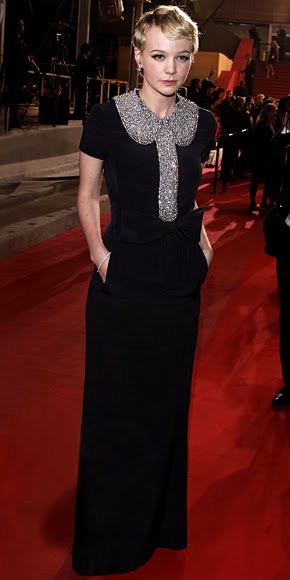
The lovely Carey Mulligan turns 25 today.
Here she is in all her idiosyncratic glory wearing a stunning Azzaro creation at the Cannes Film Festival (her look is straight out of a 1930's movie! I love it!).
Carey has two big profile movies coming later this year, do you think her star making turn in An Education was a one hit wonder or will she prove her worth in years to come?

Thursday, May 27, 2010

Defending Your Sex!


At first I thought I was being paranoid about how people are hating everything Sex but with a few hours left before the US premiere of the sequel, it's more than obvious that people have something against this movie.

For every lovely article with interesting, playful information like:

"20 Things You Didn't Know About SATC" at Sky Movies

"SATC2 Celebrity Interview Unscripted" at Moviefone

there's a distasteful, almost gratuitous attack like:

"Sex and the City 2 EW Cover: More Photoshopped Than the Poster?" at The Huffington Post (OMG do they REALLY Photoshop people in posters nowadays? *gasp*)
This one's especially hypocritical coming from a medium that highlights the Kardashian's almost naked bodies and Gwyneth Paltrow's curves in their entertainment section, yet chides the media's need to make actresses look beautiful.

Of course they also feature this in their website...


Now to breathe, there's this quite good, accurate article by someone who actually knows the show...
"In Defense of Sex and the City" at My Dog Ate My Blog

My biggest pet peeve though comes from the critical community, especially from Roger Ebert who seems to have made a mission out of trashing anything Sex.
Some of his Twitter posts read as follows:

  • 271 comments under the REEDIT link to my SATC2 review, and a lot of them are really good, by women. http://j.mp/aE5yjE
  • RT @I_AM_OZMA There is not a single thing that happens to the people on Sex & The City that I would ever want to happen to me. Those people are awful.
  • SATC "still offers the best insight into the complications of modern womanhood" says writer on Salon.com. Yes, Salon.com. http://j.mp/9DtZ2E
And just in case he didn't make clear on Twitter how much he hates it, he reminds us at his website by placing not one, but two links to his one star review of the movie.


Coming from someone who pretty much hated the first yet awards four stars to almost anything else, this has a lot to say about how he barely has mentioned he also gave bad reviews to the other big weekend releases.

Earlier yesterday Vanity Fair also retweeted an old article where their writer compares SATC fans to extremist terrorists.

A Brazilian critic I read, expressed his distaste for the movie as he tweeted during the screening. Not what I would call "professional behavior" for someone being paid to write about movies he watches, not semi-watches because he's busy tweeting how much he hates them.

Curiously most of the dissenters clarify the fact that they're not sexist or genre biased. I wonder then, whatever happens to their condemnations of extremely violent action movies? Or their love for male bonding over female disrespect in films like The Hangover?
Is it really more offensive for mature women to indulge in luxury, sex and friendship than to see a big muscled guy kill twenty nameless terrorists without a second thought?

For all I know, a shoe has done much less harm in the world than a gun.

Monday, May 24, 2010

Palme Closet Case.


It's normal to hear film snobs utter complete disdain for the Academy Awards and gloat about how the latest Palm d'Or winner is the greatest thing since bread came sliced.
But with the recent edition of the Cannes film festival, and its winners, I wondered just how different these two awards truly are.
Sure, the cinema awarded in Cannes is usually more avant garde, innovative even, compared to the array of biopics, family dramas and bloated epics Oscar favors, but the principle behind how these awards are selected might not be as far from Hollywood as the Croisette likes to think.

Each year when we hear both the Oscar nominations and Cannes festival lineup, we realize that it's the same names being called over and over.
Oscar is infatuated with Clint Eastwood, Meryl Streep, Steven Spielberg and Ron Howard. Cannes favors Ken Loach, Wong Kar Wai, Pedro Almodóvar, Emir Kusturica and yes Clint Eastwood.
This year alone Loach's new film was extraordinarily included in the official selection a mere days before the festival began.

This begs us to wonder who exactly is choosing these movies. Supposedly submitting a film into the festival is an equal opportunity for everyone (if not why to suggest it with an easy to access link in the official site?) but how will the latest film from John Doe in Mexico fare against the latest work from festival darling Andrea Arnold (Cannes' Stephen Daldry perhaps with all her films winning something)?
Sure, it can be said that Carlos Reygadas' career, for example, was built entire upon festival submissions but once he became an established member of the auteur class, is his "newbie" spot available for someone to take?

To examine this further, let's take a look at the last five Palm d'Or winners.

2010-Uncle Boonmee Who Can Recall His Past Lives
2009-The White Ribbon
2008-The Class
2007-4 Months, 3 Weeks and 2 Days
2006-The Wind That Shakes the Barkey

Out of these five, three could very well be compared to Oscar rewarding A Beautiful Mind, Million Dollar Baby and The Departed during the last decade.
As in how two of these were the eventual coronation of someone who had this award coming all along and one was the first big win for someone who was denied the top prize out of random reasons.

Apichatpong Weerasethakul's Palm d'Or triumph wasn't in the least surprising, not only because the reviews were quite good but also because since his first entry with Blissfully Yours in 2002, the young director has been escalating towards the big award.
He had movies in the official competition in 02, 04 and was a jury member in 2008. His presence in the festival is the equivalent of Tom Hanks' position within AMPAS (although it's obvious who has more artistic merits in world cinema).

When Michael Haneke finally won the Palm d'Or in 2009, it could be said that he had finally hit all the right buttons for the festival stars to align in his favor.
His first festival entry was in 1997 with the controversial Funny Games, after which came Code Unknown in 2000 (Ecumenical Prize of the jury), La Pianiste in 2001 (Grand Prize and acting awards), Caché in 2005 (Best Director award) all finally culminating with the big win four years later.
Don't get me wrong, I love Haneke (I named The White Ribbon best film of 09 as well) but the point I'm trying to make is that it might not be that necessary to nominate or award him for everything he does.

Same happened to Ken Loach who won the Palm in 2006 after having a dozen films in competition from 1981 to 2010. Can he then be the Scorsese of the Croisette?

Sure, 2008 and 2007 would prove my theories wrong, considering how both were practically surprise winners coming from literal unknowns, but you need not but take a look at those individual year's lineups to see that they were comprised of the same people.
2007 alone had films by previous winners Fatih Akin, Quentin Tarantino, Gus van Sant, Emir Kusturica and Carlos Reygadas.

Of course this also invites us to explore the relationship that exists within both events which are arguably considered the most important film awards in the world. In 2007 for example, No Country for Old Men by Cannes' darlings Joel and Ethan Coen left the festival without a single award but only because people knew it didn't need an extra hand to earn a load of awards later (same with Mike Leigh this year?).

And this is concentrating merely in the top prizes (matters like box office and distribution would require a piece of their own). This year alone we saw films by previous Best Director winner Alejandro González Iñarritu (2006 for Babel) and Palm d'Or winner Abbas Kiarostami, receive acting awards.
Is Cannes showing signs of nepotism?

When you take into consideration the fact that jury members change every year and festival history might not have a lot to do with how they decide to vote each year, everything I said might prove to be a moot point.
But can there be that much coincidence?

I would agree too that watching the new Audiard go head to head with the new Almodóvar might be much more appealing than yet another Clint vs. Marty showdown, but isn't traditionalism, whether avant garde or commercial, quite boring in essence?

Is Cannes just Oscar with a classier outfit?

Sunday, May 23, 2010

Jury Couture.

Now that the Cannes Film Festival is over, it's time to concentrate on what's really important*: how the jury members looked.

*I say this only because films out of Cannes are distributed by Satan who makes sure most of us never get to see them.

This time let's focus on the fabulous Kate Beckinsale, whose inclusion in the jury left me scratching my head. Other than her beauty has she really made a big contribution to cinema?
I mean she was excellent in Nothing But the Truth (in my mind she boycotted Naomi Watt's chances of getting an acting award for Fair Game because she essentially played the same part a mere two years ago) but other than that her filmography is quite lacking to say the least.

What she knows how to do though is wear a dress.

Let's take a look at her Cannes outfits.


She was stunning in Gucci Premiere with a color that did wonders for her.
Considering that the line debuted at the festival and everyone wore the dresses, it's pretty safe to say that Kate did it best.


She continued a current trend by wearing an Armani Privé from the moon inspired collection (I honestly haven't seen a bad dress in this collection).
The sculptural gown showed her figure beautifully and the sparkly shoulder appliqués (plus that risqué shoulder pad) are magnificent.


Some people found this Balmain to be quite unappealing for the red carpet.
But I think that considering how outrageous Cannes fashion usually is, this unorthodox color and style made a statement that recalled Rita Hayworth.


For the festival's opening night, Beckinsale chose a pale Marchesa that literally made her look heavenly.
The severe, yet playful, Pompadour gave the look a delicious old continent flavor.


In an eggplant and lavender Dior dress, the lovely jury member paved her way among the paparazzi.
Notice how she's technically wearing the same Pompadour as before but gives it an altogether different feeling with the lack of accessories.


Beckinsale was luscious in a Greek inspired Temperley London design which gave the Chopard gala a sweet, but elegant, mood.
Letting her hair down she's a walking invitation for a barefoot champagne party at the beach later.

How do you think Beckinsale fared at jury duty?

Cannes Palmares 2010.

The winners are:

Palme d'Or
Uncle Boonmee Who Can Recall His Past Lives directed by Apichatpong Weerasethakul

Grand Prix
Of Gods and Men directed by Xavier Beauvois

Best Director
Mathieu Amalric for Tournée

Best Screenplay
Lee Chang-dong for Poetry

Best Actress
Juliette Binoche for Copie Conforme

Best Actor (tie)
Javier Bardem for Biutiful

Elio Germano for La Nostra Vita

Jury Prize
A Screaming Man directed by Mahamat-Saleh Haroun