Showing posts with label Steven Soderbergh. Show all posts

Saturday, July 14, 2012

Sheet-y Saturday.

Where we take a look at posters for upcoming features.

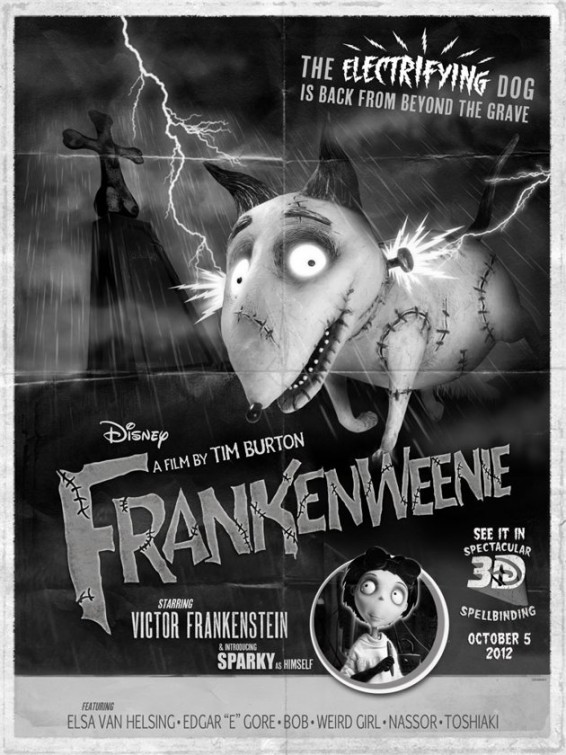
May Tim Burton redeem the last decade or so with Frankenweenie...this lovely one sheet holds the promise of some of his most iconic work and the fact that a non-cadaverous Johnny Depp is featured anywhere should be a good sign. Gotta love the folds and scratches that make it seem as if they just ran into a B sci-fi movie and are releasing it for the first time.

Magic Mike still has the best poster campaign of any movie this year. This 4th of July offering is truly delicious and not just for the obvious reasons. Just look how they completely avoided the peen to remind us that independence is all about freedom of expression.

When i first saw this poster for the last (bless you Lord) Twilight movie, I honestly thought it was a teaser for the next season of America's Next Top Model. Whoever this actress is, she's surely channeling Tyra's fierce "you go bitch" look.

Right?

Saturday, June 30, 2012

Sheet-y Saturday.

Where we take a look at posters for upcoming features.

Can we all agree this Russian poster for Magic Mike is the best poster of 2012 (so far)?
Yes? Why? do you love the bold title design and overall selfawareness as much as I do or do you think you've seen better graphic design at actual strip clubs? 

Saturday, May 19, 2012

(Very) Short Take: "Haywire", "American Reunion" and "The Vow".

Time and time again, Steven Soderbergh should be commended for being perhaps the only mainstream American director who refuses to stop experimenting with the medium. Not all of his experiments are successful but it's his willingness to keep trying that makes him such a valuable filmmaker, for example see Haywire, by hiring MMA star Gina Carano to play the lead in a movie about a female spy, instantly recalls his The Girlfriend Experience in which he hired a porn star to play an escort. To say that none of the ladies were outstanding actresses would be to say too little, but what Soderbergh achieves is to concoct a movie that feels like a documentary combined with exaggerated fiction. Sure, Carano doesn't hold a candle to the effortless way in which Michael Fassbender or Ewan McGregor move onscreen (Channing Tatum gets no such defense) but watching her fight stock actors has the urgency that matches any of their greatest performances. Other Soderbergh flourishes like stopping the score when there's a fight make for a unique experience that sadly doesn't become more than an exciting experiment.  

American Reunion is nothing more than a sad reminder that the more things change the more they stay the same. The entire gang is back (including Mena Suvari!) for their high school reunion and they have silly realizations like how "first loves are forever", "home is where the heart is" etc.
The thing that remains constant is that the film seems to gloat in the fact that these men-children refuse to grow up and celebrates them for it. The notorious Stifler (Seann William Scott) becoming nothing more than a clown who holds any inkling of a grown up life to be completely contemptible. Sure, adult life may not be all fun and games, but there is a larger problem at bay when a movie character is loved because he chooses to exist in complete denial. The movie therefore is never funny or touching - in the way the original was - instead it becomes somewhat of a horror film that like Carrie reminds us that high school can seriously mess up some people.

Pretty people having love problems has become the staple of all Nicholas Sparks movie adaptations...oh wait, what? This isn't based on a Nicholas Sparks book? Could've fooled anyone. This was a much, much better movie when it was called 50 First Dates.

Grades
Haywire **½
The Vow **
American Reunion *

Wednesday, March 21, 2012

(My) Best of 2011: Supporting Actress

5. Jennifer Lawrence in The Beaver

Jennifer Lawrence has one of those faces made to encompass the concept of All-American Girl however she has the acting chops to subvert these very notions and turn them into enigmatic traits. Take her performance in Jodie Foster's vastly underrated work of art The Beaver, here Lawrence plays Norah, a high-school girl who also happens to be a cheerleader, valedictorian and an underground graffiti artist. While lesser actresses would've conformed with letting the character do all the work, Lawrence taps onto something great: she recognizes the deep humanity that lies beneath the seemingly perfect shell and turns Norah into the most haunting characters in an already enthralling film.

4. Jennifer Ehle in Contagion

In an ensemble piece that feels more Nashville than Gosford Park it results kind of difficult for one actor to make a more lasting impact than others, particularly when their stories barely intersect and each of them end up commanding tiny movies of their own. In the case of Contagion it would seem almost impossible to choose between the impressively moving work of Kate Winslet, the vanity free performance of  Gwyneth Paltrow or the worldly wisdom projected by the lovely Marion Cotillard and yet it's the subtle work of Jennifer Ehle that stays with you and lingers for weeks after you see the movie. Playing the part of a dedicated scientist most of her scenes are actually dialogue-free. However watching the way her Meryl Streep-ian features light up is nothing if not magical. Ehle has the kind of face that evokes Falconetti and Streep in equal measures, the camera becomes so transfixed by her ethereal beauty that she needs but to muster a smile to let us into the secrets of creation.


3. Keira Knightley in A Dangerous Method

Year after year Keira Knightley seems to be delivering astonishing work that goes by without people making a fuss about it. Why? Her work in a movie like A Dangerous Method for example would get countless actresses hyperbolic comments about their craft and such. The way in which the young actress immerses herself into the character of Sabina Spielrein proves she possesses talents that go beyond her years. The way she allows the character to possess her is almost too disturbing to watch. The way in which Sabina's inner demons surface in shocking demonic moves makes Keira look completely awful, her notorious jaw and underbite deforming her lovely features and yet out of all of this - done without prosthetic work or special effects - Keira is always able to come back and find the latent humanity in this woman. She turns in absolutely moving work and steals the show from both Michael Fassbender and Viggo Mortensen; watching her squirm with pleasure as Carl Jung (Fassbender) whips her might just send you into nervous shock.

2. Jessica Chastain in The Help

We all know Jessica Chastain had the most terrific year any actress could've ever wished for. Her presence in some of the most important pictures of 2011 turned into a recurrent joke, where everyone assumed in reality she'd literally been in every single movie. The beauty of  the Chastain effect however wasn't her perseverance but the quality of her work. She was the MVP in each of those movies she was in! She created different characters whose only common denominator was the actress playing them, other than that you could never see any of her conflicted Samantha from Take Shelter in the haunting performance she turned in The Tree of Life. However even within her flawless list of performances it was her affecting turn as Celia Foote in The Help the one which might very well become the most iconic of her short career. Filling the colorful 60's costumes and donning an outrageous blond wig, Chastain plays the ultimate ditzy blond, who moves into a town where she is hated for representing everything others only dream they could be. In a movie that takes intolerance to the front of the equation, it's her beautifully nuanced performance that comments on the way in which hatred can go beyond the confines of race, sex or religion. With the comedic timing of Judy Holliday and the whoop-dee-doop sex appeal of Marilyn Monroe, Chastain is more remarkable in quiet scenes where Celia's true persona surfaces. She might be all sunshine and smiles on the outside but we learn that she crafted this persona in order to survive in a world that would crush her without giving it a second thought.

1.Charlotte Gainsbourg in Melancholia

Lars von Trier has earned a reputation for torturing and destroying any actress who come near him. This results in quite the paradox when you see the performances he gets out of women in his films. It should mean something then - both for Lars and his ways and tough love in general - to see how Charlotte Gainsbourg has flourished under his direction. She was absolutely ravishing in Antichrist turning a performance that fearlessly dared to carry all the evil of the world upon its shoulders. Conversely her work in Melancholia seems almost saintlike. Playing Claire, the sister of depressed bride Justine (Kirsten Dunst), Gainsbourg effortlessly overcomes what could've been one of the film's biggest setbacks: the fact that no one in the family seems to be even remotely related. Instead of focusing on the differences between Claire and Justine, Gainsbourg devotes her performance to making them familiar because of the intense love they share. The way in which the actress seems to take pleasure in comforting the petite Dunst exudes warmth and a humanity unlike anything you've ever seen in a von Trier film. Even as she has to cope with her own fears and pain - after all a huge planet is about to destroy Earth - Gainsbourg gives a mature, unfathomably brave performance. She only allows Claire to break down during the very last moments of the film and unlike Dunst who is always one minute away from exploding with the joys of new discoveries, Gainsbourg always seems to have the knowledge of the world. Watching the way Claire's entire life flashes by in Gainsbourg's eyes in a matter of seconds isn't only testament to her prowess as an actress, it also reminds us of the beauty and fragility of life. 

Friday, February 24, 2012

Motifs in 2011 Cinema: Disillusionment.

Perhaps because it’s one of the youngest artistic forms, cinema is often assessed in much different manner that literature, or the visual arts. We discuss it in terms of genre, not in terms of thematic offering. Comparing, for example, Corpse Bride and Up because they’re both animated leads to some dubious discussion especially when – like any art form – thematic elements examined in cinema and the way different filmmaker address them make for some stimulating discussion. Motifs in Cinema is a discourse, across nine film blogs, assessing the way in which various thematic elements have been used in the 2011 cinematic landscape. How does a common theme vary in use from a comedy to a drama? Are filmmakers working from a similar canvas when they assess the issue of the artist or the family dynamic? Like everything else, a film begins with an idea - Motifs in Cinema assesses how the use of a single idea changes when utilised by varying artists.

- Andrew K.
Disillusionment.

One of my favorite songs says "disillusion takes what illusion gives" and this couldn't ring truer than it does while looking back at the cinema of 2011. The last decade was characterized because its up and downs were more extreme than anything else in the past. When things got bad, it meant war, terrorist attacks, pandemics, severe economic crises, social revolts, harsh weather changes and natural disasters etc. When things got good - if they ever did - it seemed like the world was closer to unity. Not so surprisingly, most of the good came in direct response to the bad, with entire countries uniting to help out a smaller nation in need, technological and scientific breakthroughs and perhaps naively in the promises made by a series of politicians who for a split second seemed like they would be able to change the world.
The movies of 2011, more than before, focused on how all of the good eventually let us down, how racism, intolerance, war and corruption just might've won the battle.

In Meek's Cutoff - perhaps the most aggressive political commentary of 2011 - Kelly Reichardt questions the Obama administration's lack of direction. Her story of wandering pioneers might not seem like a straightforward "movie" in the sense that it never worries about being entertaining and has no regard for plot. However embedded in its desolated landscapes lies the greatest story never told: how people abandon everything precious to them for an ideal that might never materialize. Realizing these people are lost isn't as heartbreaking as the delusional nature of the man leading them (played with astonishing charisma by Bruce Greenwood) who is more keen on preserving his public image than on acknowledging his flaws and how he let his people down. Meek's Cutoff cleverly uses history to make a point out of the cyclical nature of our universe.

This cyclical nature is repeated in Drive a film that takes place in a Los Angeles that seems to have never moved past the Reagan era. A labyrinth of decay surrounded by neon lights, Nicolas Winding Refn's tale questions what happens when society has lost all signs of latent humanity. L.A. here becomes the ultimate symbol of disillusionment, a city where people once came to dream (there is nary a sign of Hollywood glamour, we only see the menial tasks performed by stuntmen and strippers) but now are in deep search of a hero.
That the hero they get is a morally ambiguous macho figure speaks more about how the icons of valor are thought of as primitive creatures that predate the times we live in.

The Girl With the Dragon Tattoo then gives us a hero(ine) that fits more in our times. Lisbeth Salander (Rooney Mara) might not be Homer's idea of a savior, but in these times when corporations deal with our private information, she gets the Julian Assange badge of honor for "criminal heroism". When and how exactly did telling the truth and trying to make things right by way of immorality became a sign of courage might be a task more adequate for sociologists, but we'll take our salvation in any way it comes, right?

Although salvation makes no sense when thinking that a single epidemic might invalidate all of our moral codes. In Contagion we saw how an illness not only destroyed lives but shook survivors as well. What is the point in trying to preserve any signs of humanity when we commit the greatest acts of inhumanity against ourselves?
Steven Soderbergh's masterpiece was a chilling reminder that globalization is making us stronger only by giving us a false sense of unity, when in fact countries seem to wish they could erect walls to contain their own troubles without ever recurring to "friendly neighbor" behavior. That we see so many people in the movie trying so hard to contain the pandemic and have them fail so miserably is both horrifying and somehow relieving. Does it make sense that the end of times is then becoming the hedonistic poison of choice to so many people?

The Tree of Life wasn't without loss of illusion, in fact the entire premise circles around having a son realizing he'll never satisfy his father. On a larger scale, the film is also an essay through which Terrence Malick tries to satisfy a supreme power (the ultimate father figure) by trying to find the very essence that created him. It would be facile to blame daddy issues for all that's wrong in the world (despite what Freud would prefer) but The Tree of Life pulled off the ultimate hat trick by offering us a second chance, perhaps those who have faith will find solace in an afterlife. The rest of us are stuck down here mesmerized by the way in which our hopes reach for the sky only to crash with irreverent violence.

Monday, January 23, 2012

Head over to PopMatters and read our list of the Best Movies of 2011. There is NO arguing with the Top 3 but if you want to go right ahead and read my entries, check out numbers 23 and 7. Actually no, read them all!

Thursday, November 10, 2011

Contagion ***½

Director: Steven Soderbergh
Cast: Marion Cotillard, Matt Damon, Laurence Fishburne, Jude Law
Gwyneth Paltrow, Kate Winslet, Jennifer Ehle, Elliot Gould
Sanaa Lathan, John Hawkes, Bryan Cranston

Contagion opens inside an airport bar where American businesswoman Beth Emhoff (Paltrow), on her way to the States from Hong Kong, sits having a drink and talking on the phone while she waits for a connecting flight. As she hears her flight number being called out she leaves the bar. The camera then focuses on the small bowl of peanuts that sat in front of her. A title card reading "Day 2" appears. With a seemingly innocuous choice of editing, camera positions and additional information (we don't get title cards in real life), Steven Soderbergh sends us down a spiral of fear, the likes of which we rarely see in contemporary cinema.
Once Beth is back in the States, she suddenly falls ill with a strange disease that sends her into a coma and kills her a mere minutes after the movie begins. With this bold move Soderbergh reassures us that for the next two hours, no one will be safe.
Contagion then deals with the discovery, propagation and consequences of this new lethal virus that is transmitted by contact and has no apparent cure. As the virus grows, we meet different characters who deal with it in their part of the world as society around them begins to crumble. Soderbergh also divides them into different aspects of our current world, without making them a too obvious "group". We see the emotional part with  Beth's husband, Mitch (Damon) for example, who has to deal with his wife's sudden death as he must survive in order to support his daughter.
There's also Dr.Ellis Cheever (Fishburne) of the Centers for Disease Control and Prevention, who tries to clear doubts that suggest the new virus might be a bioweapon by sending his colleague Dr. Erin Mears (Winslet) to investigate. Their stories are more related to bureaucracy and the handling of disasters by local governments which provide the film with eerie echoes of the H1N1 epidemic and the way in which the American government has dealt with events like Hurricane Katrina and the oil spill in the Gulf of Mexico.
Their storylines are also linked to the scientific community represented by Gould, who plays a genius biology professor and Ehle, who plays Dr. Ally Hextall, a CDC scientist commissioned to find a vaccine.
As the story begins to occupy a more global aspect, we meet Dr. Leonora Orantes, a World Health Organization epidemiologist who is sent to Asia in search of "patient zero". Scenes involving her character are filled with an exotic dread in which we are reminded that despite the world's global union feeling, we are still pretty much on our own. Soderbergh makes her scenes scary and mystifying by recurring to the use of multiple languages which instill a very primal fear in audience members. Is he perhaps suggesting that xenophobia is acceptable under special circumstances?
Other characters include slimy conspiracy theorist/blogger Alan Krumwiede (Law), a down on his luck janitor (Hawkes) who finds himself in the midst of a disease which to him remains incurable due to his lack of money and Aubrey (Lathan), Dr. Cheevers partner who gets involved in a political disaster.
Soderbergh has proved in the past that he's a maverick at handling parallel storylines with unifying, often enlightening, clashes. But while in Traffic he did something a bit more orthodox in terms of dramatic structure, Contagion offers him the chance to do his own hybrid of Nashville and Outrbreak. Those expecting an ultimate message of salvation, or even a unifying climax will come out severely disappointed as Soderbergh makes a case of maintaining the pieces of his mosaic separated.
Their detachment might come off as cold-hearted by usual standards but Soderbergh sees himself as a scientist trying to dissect the various pieces of his experiment (an autopsy scene is done with such straightforwardness that you can't help but feel both revolted and mesmerized). He leaves it to his actors to create flashes of humanity within the hyper-realism of his direction. Cotillard for example brings a worldly charisma (and a serious working woman hairdo) to her scenes, while Ehle becomes a joy to watch as she puts all of her Streep-ian attributes to work as she delights herself with her work discoveries.
Paltrow, who the film sometimes uses as a morality clause, is haunting, as she represents the face of an irresponsible (if only by ignorance) branch of American society and Winslet delivers one of the year's most powerful emotional punches in less than ten scenes.
His insistence to keep the stories from coming together has a remarkable symbolism because we realize that he's trying to contain infection from seeping to his other characters. By maintaining them apart, Soderbergh might be making the film's strongest point which is a questioning of the benefits of globalization.
This is confirmed in the finale which might be a bit facile but still shocks us to our very core by reminding us that by trying to make the world a smaller place, we have also made its decay much easier to obtain. With his expert use of editing, cinematography and sound (there are scenes without dialogues that creep under your skin) Soderbergh creates the kind of movie that transcends genre but becomes effective even within them. The film is scary because it feels possible and its use of scientific fact and borrowing from contemporary history only makes it more valid.
Martin Scorsese said that horror is related to physicality but terror is more related to what we feel, with Contagion Soderbergh might've created one of the most terrifying films of the decade.

Saturday, July 23, 2011

Sheet-y Saturday.

Where we take a look at posters for upcoming features.

Andrew Niccol doing sci-fi? Count me in! However I'm still unsure of what exactly does Justin Timberlake's "acting" bring to the movies...
Also this poster looks like a CK ad.

The next two posters are for the new Steven Soderbergh movies and ugh, this man is a genius. He hand picked the designers for his marketing campaign and chose some of the best in the business (the ones that make Criterion covers...)
The one for Contagion has a District 9 feel and truly what stands out in this poster, and also in the one for Haywire is that Soderbergh goes beyond the worshiping of the movie star...


...he has some of the greatest living actors in these two movies, also some of the most beautiful people. Yet on the posters he goes for an appraisal of graphic design as an art form. The one for Contagion has a very retro touristy feel. As if disease took over the mentioned cities. It's also important to mention how influenced by industrial design are these posters. The first one loves typography while the one for Haywire pays tribute to the great Saul bass and to iconic movie posters of the 70s without obviously ripping them off.
I have to admit I don't even miss seeing Fassy's gorgeous mug in it...

Excited about the new Soderbergh flicks?

Saturday, July 16, 2011

Sick!

I am dying to see this movie, pardon the pun and I discussed the trailer over at The Film Experience, so go check it out!

Monday, July 20, 2009

While Watching "The Girlfriend Experience"...


I realized that the Audrey Hepburn look from "Breakfast at Tiffany's" is perhaps the most overused styling done for female actresses of all time.
Hair up in a bun, clean cut black dress and shades are the epitome of classy simplicity.
Of course Sasha Grey plays an escort in this movie and Holly Golightly was one as well, even if the movie de-sexuallizes her too much.
But beyond this too specific homage from Steven Soderbergh, and his costume designer, the look has also been used recently in films like "Sex and the City".
Where else have you seen it?

Sunday, July 19, 2009

The Girlfriend Experience ***


Director: Steven Soderbergh
Cast: Sasha Grey, Chris Santos, Peter Zizzo

Steven Soderbergh's latest hi-def, low budget experiment takes us inside the life of high class escort Chelsea (Grey).
Set in the days leading to the 2008 elections in the United States, most of the characters' conversations revolve around Obama, the debates and the recession.
Therefore most of Chelsea's clients end up talking about contracts that worry them or advice her how to invest, instead of having actual sex.
She doesn't have sex with her boyfriend Chris (Santos) either as he spends all his time in the gym where he works or looking for new ways to make money.
Why then, one could ask, would Soderbergh cast professional porn star Grey to fill in a role that doesn't need her to do what she does best?
This is one of the director's many subtle commentaries contained in the film. This isn't a film about sex, but about transactions and sex as a transaction.
The title experience for example refers to a practice where men pay a sex worker to act like their girlfriend.
And not in some sort of emulation mode, if they have actual partners, but to act like they think a girlfriend should. Chelsea therefore nods, agrees with them, caresses their hair and then gives in to whatever their favorite sexual practices are.
Soderbergh's film is about the disappearance, and search, of the sexual fantasy as we once knew it. Has sex in fact stopped being a priority in the face of economic downfall?
The film is shot in cool hues, static closeups and smooth moves, as if we were watching an ad for a high end product. Said product would be Chelsea of course and she does her best to seem like an unreachable object of desire.
Grey who is featured in almost every scene does a remarkable job. She does what very few actors can do well: listen.
She listens so much to others that sometimes she seems to have disappeared. In several scenes she's left out of the frame while someone talks to her, or our view of her is blocked by her companions.
But at the center of this we have to wonder how much it's Grey acting and how much it's Chelsea acting. Chelsea after all is paid to do whatever her clients want her to do.
Soderbergh must've been aware of the post modernist implications in this and he does give the film a few more, hilarious inside jokes.
Like the brilliant casting of film critic Glenn Kenny as a man who offers to write a review for Chelsea in exchange for a complimentary taste of the goods.
His eventual review of her is laugh out loud funny and very bitter, leading us to die and see what Kenny ended up actually saying about the film as a whole.
It's also interesting how Soderbergh might be trying to say something about art with this statement. Are the movies he gets paid for the most the only ones he counts as art? There is much to see and think about in "The Girlfriend Experience" but only if you're willing to go with its flow...don't expect this movie to hold your hand.