Showing posts with label Sean Durkin. Show all posts

Sunday, April 15, 2012

(My) Best of 2011: Director

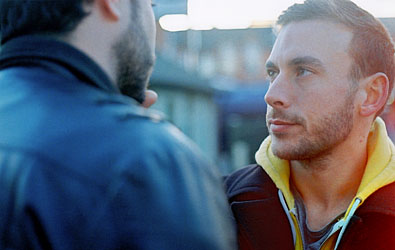
5. Andrew Haigh for Weekend

What Andrew Haigh does with his camera in Weekend defies the cinematic idea of intimacy, because we forever wonder: how did he get his actors to become so unaware that they were playing characters and were being filmed? Not even pornographic films, which are supposed to be chronicling moments of complete intimacy, are able to make us feel like we're invited to the party. The way in which he managed to get the equipment and crew inside Russell's (Tom Cullen) little apartment from example at some point or another would've demanded that we became aware of the limitations imposed to movement. However this never happens, all along we're meant to feel not like voyeurs but like guests. Whether Haigh invited us to make us more aware of social causes or merely because he wanted to give us a taste of what falling in love feels like, he is always leading us without us feeling directed. He finds sublimity in the subtle.


4. David Fincher for The Girl with the Dragon Tattoo

Who would've guessed that David Fincher would craft his most personal movie to date, from an international best-seller which had already been turned into a movie? His take on The Girl with the Dragon Tattoo isn't only a procedural thriller, but an open dialogue with a universe he still doesn't get. If god talked through Terrence Malick in The Tree of Life, Fincher talks through god as he wonders about the way in which the human race has turned the notion of civilization into chaos. Why are the Adams of the world so keen on destroying the essence of the Eves? Why is history so important and yet disregarded with such ease at one's convenience? Why can't nature and progress go hand in hand? Fincher shows us a dark, icy world in which humans have become nothing more but pieces of ice, awaiting a thaw that might just never arrive.


3. Woody Allen for Midnight in Paris

Not since Manhattan had Woody Allen delivered such an endlessly pleasurable work of art. You're thinking The Purple Rose of Cairo or Hannah and her Sisters, right? Yet even those dealt more strongly with deeply melancholic currents of thought. In those movies he questioned the universe, in this one he questions and then seems to find enlightenment in the lack of an answer. His previous effort was a movie that came out with harsh, bitter tones, something acceptable but that reflected awfully because for a moment it teased of a career that would go downhill from there. Perhaps Midnight in Paris resulted so successful because it was a surprise. Not everyone can grab life and find hidden gems among its every day misery in the way Woody can.


2. Sean Durkin for Martha Marcy May Marlene

Not since Joshua Marston's Maria Full of Grace had a feature length debut felt so electrifying and had such subtle "look at me" power. Is it a coincidence that both movies are commanded by strong female characters undergoing extraordinary situations? Perhaps not. The one true thing is that both debuts felt like the work of masters of the art form, only leading us to wonder, how will they ever be able to top this?


1. Lars von Trier for Melancholia

The mad Dane has done it again! After his previous movie which was an undeniable masterpiece, he might've actually gone ahead and delivered the most flawless movie of his already breathtaking oeuvre. His gorgeous Melancholia followed a pattern that was quite common in 2011 films: realizing that the world sucks, that humanity is rotten and that this might all just implode one day, but still they found something beautiful among the decay (see Drive, Midnight in Paris, The Girl with the Dragon Tattoo, Bridesmaids, Shame). What makes Melancholia different from all of these movies is that each and every frame in it shined with the sort of artistry that eludes most filmmakers for as long as they make movies. To see how Lars orchestrates chaos and turns it into a gargantuan opera conformed by sensitive, chilling arias is nothing if not mesmerizing and despite his film's tragic finale, it reassures us that if there is a god, he wouldn't want to destroy a civilization capable of creating such beauty.

Tuesday, March 20, 2012

(My) Best of 2011: Supporting Actor

5. Kiefer Sutherland in Melancholia

Lars von Trier's movies never seem to give space for his male actors to thrive. More often than not men are "pawns" of sorts in the larger scheme of the female driven universes created by the mad Dane. Just think of the fates of Willem Dafoe in Antichrist and Stellan Skarsgard in Breaking the Waves. Because it's often the women who give the most arresting performances in his movies, it seems that the men are a bit underrated and what he achieves with Kiefer Sutherland in Melancholia should by no means go by unnoticed. Playing the loyal husband of Claire (Charlotte Gainsbourg) he divides himself drastically in the movie's two chapters, in the first he has to play a strong head-of-the-house who tries to make his sister-in-law (Kirsten Dunst) understand that despite his affection for her, he is still the, literal, king of his castle. His strong charisma shifts in the latter chapter to give way to a man who quite simply loses all faith in the things that had supported him before: science and love. Watching his destruction parallel to the "larger" events going on might be all the more haunting because Sutherland never allows his character's limitations to prevent him from being completely unforgettable.

4. John Hawkes in Martha Marcy May Marlene

There is something so seductive about John Hawkes in this movie that defies all laws of attraction. Why would anyone want to be with someone who forces them into an alternative but violent cult, constantly rapes you, makes you fall in love with him and then not only ignores you but makes you aid him in finding new lovers? Yet somehow that's what he does as Patrick, in Sean Durkin's remarkable directorial debut. There is something so effortless about the way in which Hawkes movies in front of the camera, something so menacing about the way he looks when he smiles and yet we totally "get" why the title character (Elizabeth Olsen) can't stay away from him for long. This performance must be what they mean by "magnetic".

3. Chris New in Weekend

New is the epitome of alluring in Andrew Haigh's Weekend, what's so remarkable and fascinating about his character and his performance is how completely blasé he seems while harboring an explosive combination of emotions inside. His Glen seems like a free spirit, a bit on the politically incorrect side but the actor goes beyond the confines of the "bohemian" character's traits and finds something rather touching in him. The way in which Glen always seems to be both intensely interested in Russell (Tom Cullen) while wanting to run away, punches you right in the gut in the most unexpected moments. His line deliveries are magical and there's no way you would be able to say no to having him tape your sexual history. On a shallow note - which somehow adds to the constant wonderment of his performance - never expected him to be the top.

2. Bruce Greenwood in Meek's Cutoff

There is very little information on who Stephen Meek was exactly, yet what Bruce Greenwood does in Kelly Reichardt's revisionist western feels as if someone found a time machine and brought the legendary explorer back to life. Greenwood is practically unrecognizable behind the shaggy beard and oversized hat that Meek wears and his performance may lack the "excitement" associated with playing historical figures. Yet perhaps because the actor had a pretty much empty canvas to portray the character as he found fit, he comes up with a thing of true beauty, creating a harsh, soulless creature that demands your attention and always ends up winning your favor. No other performance in 2011 captured the "rock star"-ness of current politics like this one, he reminded us that we're living in a world where politicians need only but to charm us before we are willing to get lost in the labyrinth of their lies.

1. Corey Stoll in Midnight in Paris


It must be telling that while Woody Allen has abstained of tackling biopics or historical characters throughout his legendary career, several of his fictitious creations seem to take on a life of their own outside the realms of his movies. Try convincing people that Zelig wasn't a real being, that you can't find Emmet Ray albums in record stores or that Hannah and her sisters don't actually live somewhere in NYC... It was a real surprise then to see him explore some of the most famous artists of the 20th century in his enchanting Midnight in Paris, which not only resulted in the best movie he's done in over twenty years but also reminded us of the Woodsman's more playful side. Allen has always tried to represent and preserve his personal tastes through his movies and it makes sense that the ones in Paris are some of his all-time favorites, what's remarkable is how he manages to give them their own life while imprinting the Woody Allen touch on them. Best in show is Corey Stoll who fills the screen with testosterone and bravado playing none other than Ernest Hemingway. Even when he's reciting passages of Hemingway's life adjusted to the straightforward nature of his writing, Stoll gives the legend a suspicious earthy feeling. No scenes in the movie feel as alive as those that feature him and the way he always looks into the horizon as if both recalling specifics and planning his next masterpiece will certainly leave you wanting more.

Tuesday, February 7, 2012

Martha Marcy May Marlene ***½

Director: Sean Durkin
Cast: Elizabeth Olsen, John Hawkes
Sarah Paulson, Brady Corbet, Hugh Dancy, Maria Dizzia, Julia Garner

Martha Marcy May Marlene begins with an escape: we see how a young woman (Olsen) having made sure no one is watching her, picks up a small bag and runs into the woods. Not a minute passes by before she is pursued by a group of people calling out her name "Marcy May! Marcy May!". The young woman hides from them - the look on her face one of complete dread and fear - before she feels safe to continue on her way.
Next, she picks up a pay phone, the woman on the receiving end asking "Martha is that you?", before the caller begs her to come find her. Sean Durkin's debut feature film begins with a bang - albeit an understated one - making us wonder how did this fragile looking woman, end up being known by two different names and what exactly is she running away from.
We learn soon that the woman Martha contacted is her sister Lucy (Paulson), a WASP-y well-doer who picks up her damaged little sister and takes her back to the summer house she shares with her husband, Ted (Dancy).
Lucy seems to be used to Martha pulling off these stunts and immediately assumes that she just got dumped by "some boyfriend". Martha decides to please her and just nod in agreement of whatever she says, without letting her know that she in fact was escaping from the overpowering abuses of a cult she'd joined.
Memories of the way she was forced into submission by, charismatic cult leader, Patrick (Hawkes) begin to haunt her and eventually she becomes convinced that her fellow cult members are coming to get her.
Durkin, who also wrote the screenplay, lets the story flow effectively on two levels, for we never know if Martha's fears are founded on reality or merely part of a persecution delirium.
Durkin's storytelling is so tight and controlled that the movie can work on both levels simultaneously, becoming a creepy thriller about cults as well as a superb study on the frail dynamics between fantasy and reality.
The director amps up the feeling of constant fear by relying on very basic techniques like ambiguous dialogues, a brilliant work of editing that blurs the lines between past and present and a camera that fixes itself on its subjects until it decides to zoom slowly towards them. It's in these moments when the camera tries to get closer that the film's themes manage to get under your skin.
That the camera has such an effect isn't just owed to the cinematographer, but also to Olsen who delivers an exquisite performance. Slowly she becomes one with every other element in the movie: the camera flashing us with the unconscious threats that plague her existence, the editing showing us that her present is constantly disturbed by images of her past and the sound design creating a world view that's haunted in the strictest sense of the word.
Lesser actresses would've let the screenplay's powerful story define their character, Olsen instead taps into something that's both disturbingly primal and beautiful to watch. She creates a persona for each of the women contained in the film's title, her Martha being a wild child who was always in the lookout for a deeper existence, her Marcy May being an illusion-filled girl whose crush turned into a nightmare and her Marlene being a completely fictitious creation that defines this woman's darkest intentions.
Olsen is able to overcome the fact that the movie could've easily become a critique of cults, instead making us understand why someone like Martha would be eager to be seduced by the "love for all" facade offered by strangers.
Watch the scene in which Patrick tells her "you look like a Marcy May", Hawkes complying with the slimy, but undeniably sexy, traits someone would need to convince you of joining their cult and Olsen displaying an almost childish coyness, surprised and moved that someone looks through her this way.
That Martha, Marcy May and Marlene never become completely defined people is testament to Olsen's capacity of inhabiting several lives, trying to find different truths in each of them, the only universal one - and also the film's chilling bookend- being that whoever she really is, she'll never be able to escape from herself.